
DEPREM İZOLASYONU (SİSMİK İZOLASYON) NEDİR?

Büyük bir depremden insanların sağ çıkmasını sağlamanın yanı sıra, sosyal ve ekonomik faaliyetlerin sürdürülebilmesi gibi amaçlarla, yapıların işlevlerinin kesilmeden devam etmesi gerekliliği ve/veya talebi de söz konusu olduğunda, mevcut deprem yönetmeliklerinden daha ileride bir tasarımın gerekli olduğu aşikardır. Bu noktada en güvenli, çağdaş ve güncel yöntem DEPREM İZOLASYONU teknolojisidir. (Sismik İzolasyon ya da Sismik Temel İzolasyonu olarak da bilinir.)
Bir yapının sahibi veya yöneticisi, ne büyüklükte bir deprem olursa olsun, depremden hemen sonra evine, işyerine girip normal hayatına, üretimine kaldığı yerden devam etmek istiyorsa, işte bu noktada klasik deprem yönetmelikleri yetersiz kalmakta ve deprem izolasyonu teknolojisi kaçınılmaz olmaktadır. Çünkü deprem yönetmeliklerinin amacı sadece can güvenliğidir. Oysa büyük bir depremin ana ve artçı şokları sadece fiziksel olmayıp aynı zamanda ekonomik şoklar da yaratmaktadır. Bu sebeple deprem sonrasında oluşacak zararlar, yapılarda gözle görülen somut hasarların çok daha ötesine, önceden görülmeyen boyutlara uzanabilmektedir. Zararın gerçek boyutu haftalar, aylar, hatta yıllar geçmeden tam olarak anlaşılamayabilir. Maalesef birçok kuruluş ve şirket, bu tür ekonomik artçı şoklara karşı güvencede değildir.


Şirketlerin ve kurumların günlük operasyonlarının kesintiye uğraması riskini ortadan kaldıran teknoloji DEPREM İZOLASYONU’dur.
“Seismic Isolation System”, proven during large-scale earth tremors
To reduce the potential damage caused by earthquakes, past methods increased the building rigidity by adding shear walls or braced frames. The “Seismic Isolation System” is a flexible approach for isolating the structure from the ground, reducing seismic shock propagation into the structure.
In addition to reducing the chance of structural damage, the “Seismic Isolation System” also minimizes secondary damage to equipment inside the building such as computers, precision instruments, medical equipment and communications systems.
The “Seismic Base Isolation System” is installed between the ground and the upper structure. The isolated rubber bearing proven to be an ideal solution for seismic base isolation.
New Structure Technology – “Seismic Base Isolation System”, proven during large-scale earth tremors
The Seismic Isolating Rubber Bearing consists of alternating laminations of thin rubber layers and steel plates (shims), bonded together to provide vertical rigidity and horizontal flexibility.
Vertical rigidity assures the isolator will support the weight of the structure, while horizontal flexibility converts destructive horizontal shaking into gentle movement.
- Cover rubber
- the outer cover protects rubber laminations against ultraviolet rays and ozone exposure that deteriorate rubber.
- Bonding
- through a proprietary surface treatment prior to vulcanization, the individual rubber layers and steel shim plates are permanently bonded together between the upper and lower flanges.
Principle of Laminated Rubber Bearing
A standard rubber block can be easily compressed and sheared because of its biaxial softness. A laminated rubber bearing can be easily sheared, but its high vertical stiffness allows it to support a heavy structure such as a building.
DR | High Damping Rubber Bearing
[Certifications(Minister of Land, Infrastructure and Transportation)] MVBR-0468(X0.4R)、MVBR-0430(X0.6R)
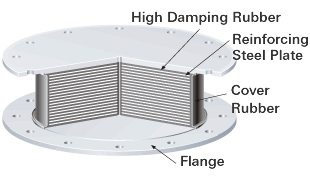
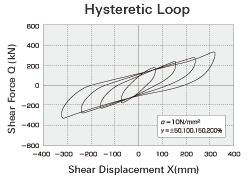
Rubber bearing that uses high damping rubber; where the rubber material itself demonstrates spring and damping capability. Generally, separate damper is not required; good for space-constraint installation.
Since its hysteresis curves are relatively smooth, seismic isolation effect can also be expected for in-building precision equipments, etc., rather than for buildings only. Rubber material has two different kinds of elastic modulus(refer red as E0.4, X0.6R), it’s also applicable to light column load.
LRB | Lead Rubber Bearing
[Certifications(Minister of Land, Infrastructure and Transportation)] MVBR-0447
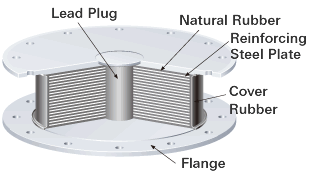
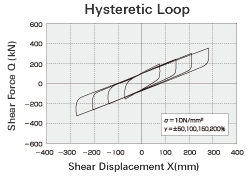
Rubber bearing that has a lead plug embedded at the centre of laminated natural rubber; where the”laminated natural rubber” demonstrates spring capability, while the “lead plug” demonstrates damping capability.
Generally, separate damper is not required; good for space-constraint installation. It shows hysteresis of elasto-plastic characteristics, and it is possible to fine adjust the attenuation setting by varying the lead plug diameter.
Only one kind of rubber material is used.(referred as G0.40).
NRB | Natural Rubber Bearing
[Certifications(Minister of Land, Infrastructure and Transportation)] MVBR-0295(N3.G3.G5),MVBR-0446(G4)
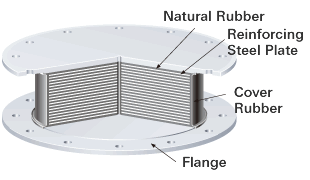
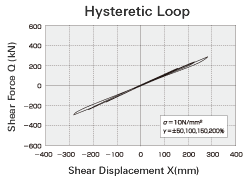
Rubber bearing that uses natural rubber. It has low damping performance (about 2~3% at equivalent damping factor), excellent linearity, and stable restoring force characteristic.
Separate damper is required, but with combination of damper types, attenuation, etc., it is possible to design with greater flexibility.
Rubber material has four different kinds of elastic modulus(referred as G0.30,G0.35,G0.40, G0.45), able to support wide range of column loads.
Elastic Sliding Bearing
[Certifications(Minister of Land, Infrastructure and Transportation)] MVBR-0349(SL series),MVBR-0469(SP series),MVBR-0479(SK series)
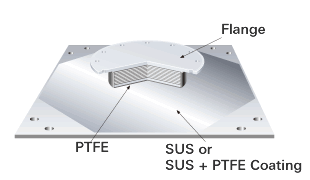
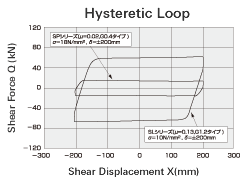
It is consist of 2 pieces: 1) a natural rubber bearing bonded with PTFE(Teflon) material and 2) a stainless steel slide plate. Small displacements are absorbed by the rubber itself, while large displacements cause the rubber bearing to slide on the plate.
Since the restoring function will be lost when the sliding occur r ed, normally it is used in combination with NRB, LRB or HDR.
There are three different type offriction coefficient, which type to be used is based on necessity of damping.

 NEDİR? Büyük bir depremden insanların sağ çıkmasını sağlamanın yanı sıra, sosyal ve ekonomik faaliyetlerin sürdürülebilmesi gibi amaçlarla, yapıların işlevlerinin kesilmeden devam etmesi gerekliliği ve/veya talebi de söz konusu olduğunda, mevcut deprem yönetmeliklerinden daha ileride bir tasarımın gerekli olduğu aşikardır. Bu noktada en güvenli, çağdaş ve güncel yöntem DEPREM İZOLASYONU teknolojisidir. (Sismik İzolasyon ya […])
About The Author
admin